

The History of Cheating in Online Games: From the Konami Code to DMA Attacks and AI (1980–2026)
When ping is stable and hit registration is flawless, the only factor ruining the competitive gaming experience is software interference. The history of cheating has come a long way from innocent QA department tools of the 1980s to a transnational criminal industry generating hundreds of millions of dollars. Today, the technical arms race has long abandoned user mode (Ring 3) and descended into the OS kernel level (Ring 0), and by 2026, it has fully transitioned to the hardware level using direct memory access (DMA) and machine learning.
When breaking down what game cheating means today, you have to throw out the old stereotypes of kids downloading sketchy .exe files. Today, it’s an entire ecosystem of private developments that relies on hypervisor vulnerabilities, PCIe bus exploitation, and cryptographic bypasses. The cheating problem has reached such a scale that developers are forced to require players to enable hardware encryption modules (TPM 2.0) just to launch a shooter.
Key Takeaways
The evolution of unfair play is an ongoing architectural war between anti-cheat developers and exploit creators. Online cheating has long ceased to be software hooliganism; it has become reverse cybersecurity.
- Origins: Early cheat codes (like the
Konami Code) and hardware modules were created legally for game debugging and to save testers' time. - Network Architecture: The introduction of
Client-Side Predictionin the 2000s birthed the classicAimbotandWallhackdue to the necessity of storing enemy coordinates in the client's RAM. - Architecture Shift: By 2015, the war moved into the operating system kernel (
Ring 0), where anti-cheats and rootkits gained equal memory access privileges. - Hardware Bypass: In 2026, the landscape is dominated by
DMAboards (reading RAM while bypassing the CPU) and AI pixel bots powered by machine vision (YOLO). - Industry Response: Modern anti-cheats (Vanguard, Ricochet) leverage hardware roots of trust (
TPM 2.0,Secure Boot) and memory isolation viaIOMMUto physically block exploits.
Below, we’ll break down each stage of this technical arms race in detail and explore how the most complex server deception mechanisms work.
The 8-Bit Era: Debugging, POKE, and Game Genie (1970s–1990s)
When newcomers ask what cheating means in the context of retro consoles, the answer surprises many. Originally, it wasn't about gaining an unfair advantage over others. Early game developers needed a way to test complex levels without spending hours playing through them manually.
In 1986, while porting the arcade game Gradius to the NES, programmer Kazuhisa Hashimoto realized the game was too difficult for proper QA testing. He coded a sequence of inputs (Up, Up, Down, Down, Left, Right, Left, Right, B, A) that granted a full set of power-ups. The code was accidentally left in the retail release and went down in history as the Konami Code, becoming a massive cultural phenomenon.
The POKE Command: How Gamers Hacked the Commodore 64
If you're wondering what cheats are at the fundamental machine logic level, look no further than early home computers like the Commodore 64 and ZX Spectrum. Users had direct access to the BASIC interpreter. The POKE command allowed them to write specific values directly into RAM addresses, while PEEK allowed them to read those values.
Players published memory address tables in gaming magazines: typing POKE 47196,201 gave a character infinite lives. This laid the foundation for future trainers and software like ArtMoney or Cheat Engine—direct manipulation of allocated RAM.
Game Genie and the Fair Use Precedent
In 1990, Codemasters released the Game Genie—a device that plugged in between the game cartridge and the NES console. This wasn't a software hack, but a hardware Address Bus interceptor. When the CPU requested data from the cartridge (e.g., subtracting health), Game Genie intercepted the request and modified the value on the fly.

Nintendo sued, accusing the creators of modifying copyrighted code. However, in 1992, the appellate court ruled (Lewis Galoob Toys v. Nintendo) that temporarily altering data in RAM without modifying the source code fell under the Fair Use doctrine. This landmark ruling essentially legalized hardware tampering and modding in video games.
The Dawn of Multiplayer: Aimbot, Wallhack, and Network Exploits (2000s)
With the rise of multiplayer games, local memory alteration was no longer a simple fix. The server became the ultimate arbiter. But to ensure smooth gameplay on the slow internet connections of the 2000s, developers introduced Client-Side Prediction. The client had to know where enemies were in advance, even if they were behind a wall, to render them without delay when they peeked out of cover. This specific architectural quirk birthed cheating in online games.
The Anatomy of Wallhack and Aimbot: Inside the Memory
Users often ask: how do basic cheat mechanisms work in online games? Unlike in the movies, hackers don't need to "hack the server." All the necessary information is already sitting right there on the client's PC.
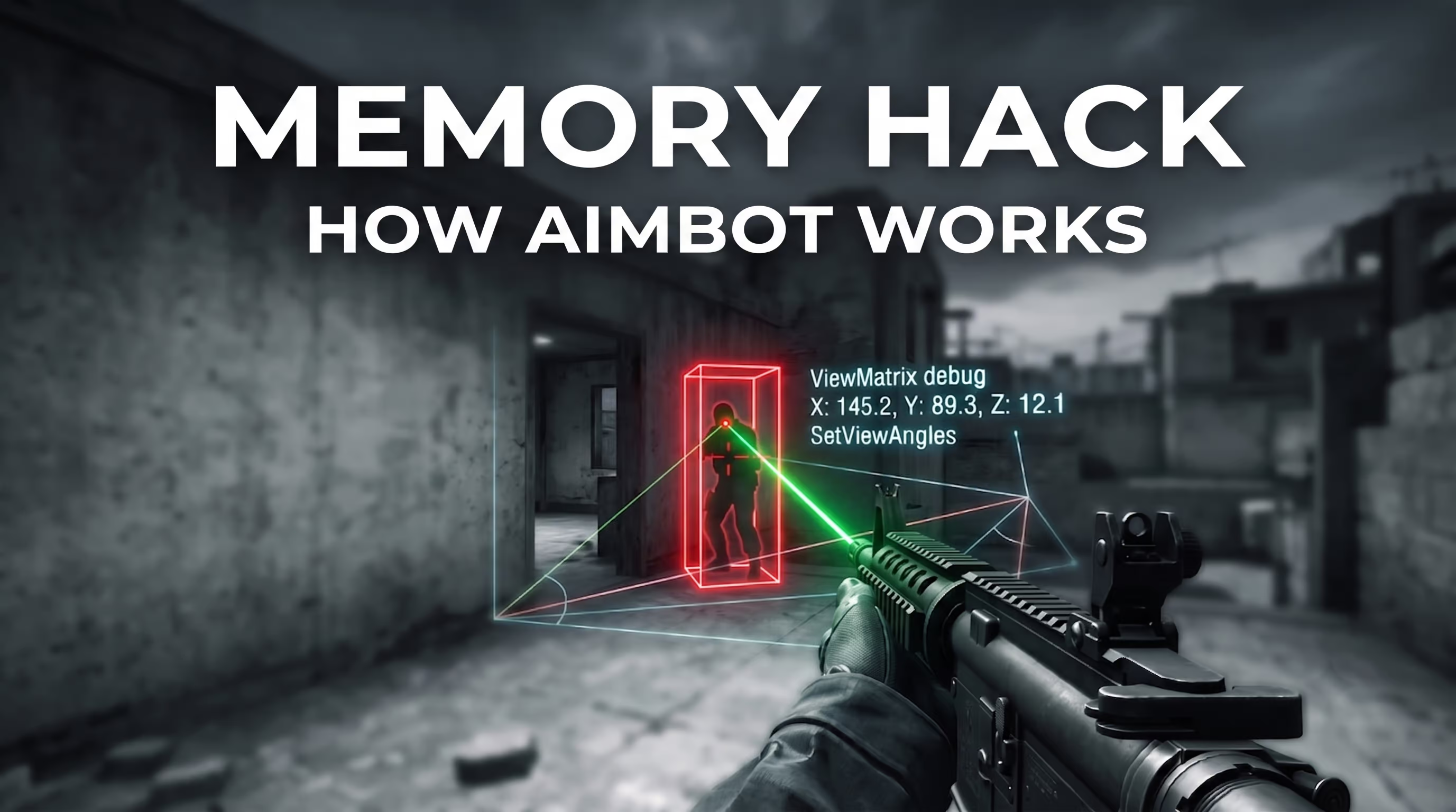
Wallhack (WH) works by manipulating the graphics pipeline. Early versions simply disabled the Z-buffer (depth buffer), forcing the GPU to render player models on top of all wall textures. Later, coders learned to read the Entity List and ViewMatrix from the game's memory, projecting 3D enemy coordinates onto a 2D screen as bounding boxes and skeletons.
Aimbot operates on a similar principle. The software reads the enemy's head coordinates from the Entity List, calculates the vector from the player's camera to the target, and sends a command to adjust the viewing angles (SetViewAngles) using DLL injection (API Hooking).
Radar Hacks and the Era of Unencrypted Packets
By 2018, Radar Hacks had gained massive popularity, operating via Man-in-the-Middle (MITM) attacks. Players ran the game on their primary PC while routing network traffic through a second laptop equipped with a packet sniffer (like a Pcap-based tool). Because early versions of PUBG and Escape from Tarkov transmitted UDP packets containing loot and enemy positions in plaintext, the second PC simply drew a 2D radar, completely untouched by the actual game process memory.
This method was completely invisible to anti-cheats. The era only ended with the widespread implementation of TLS/DTLS network traffic encryption. Without the private session key, intercepted packets just became unreadable cryptographic noise.
The Architecture War: Ring 3 vs. Ring 0 (2010s)
For a long time, the cat-and-mouse game between security devs and cheat makers took place in Ring 3—the Windows user-mode space. Anti-cheats like VAC (Valve Anti-Cheat) scanned memory for known cheat signatures, functioning much like an antivirus. However, VAC, deeply integrated into Steam, relies on delayed ban waves to prevent cheat developers from figuring out exactly when their software was detected.
Realizing that an anti-cheat running in Ring 3 could be easily fooled (e.g., by denying it read access to a specific memory sector), security module creators moved their drivers into Ring 0—the OS kernel. BattlEye and EAC (Easy Anti-Cheat) gained the highest possible system privileges.
The response was immediate. Private cheat developers began signing their drivers with stolen digital certificates or exploiting vulnerabilities in older, legitimate drivers (BYOVD — Bring Your Own Vulnerable Driver) to breach Ring 0 as well. A symmetrical rootkit war began. Techniques like DKOM (Direct Kernel Object Manipulation) were used to hide processes, and SSDT Hooking intercepted kernel calls directly.
For a deep dive into the architectural vulnerabilities of netcode and kernel driver interactions, we highly recommend checking out the technical articles on the cheat.bz blog, where we dissect game engine algorithms in detail.
The Modern Era: DMA, Hypervisors, and AI Bots (2020–2026)
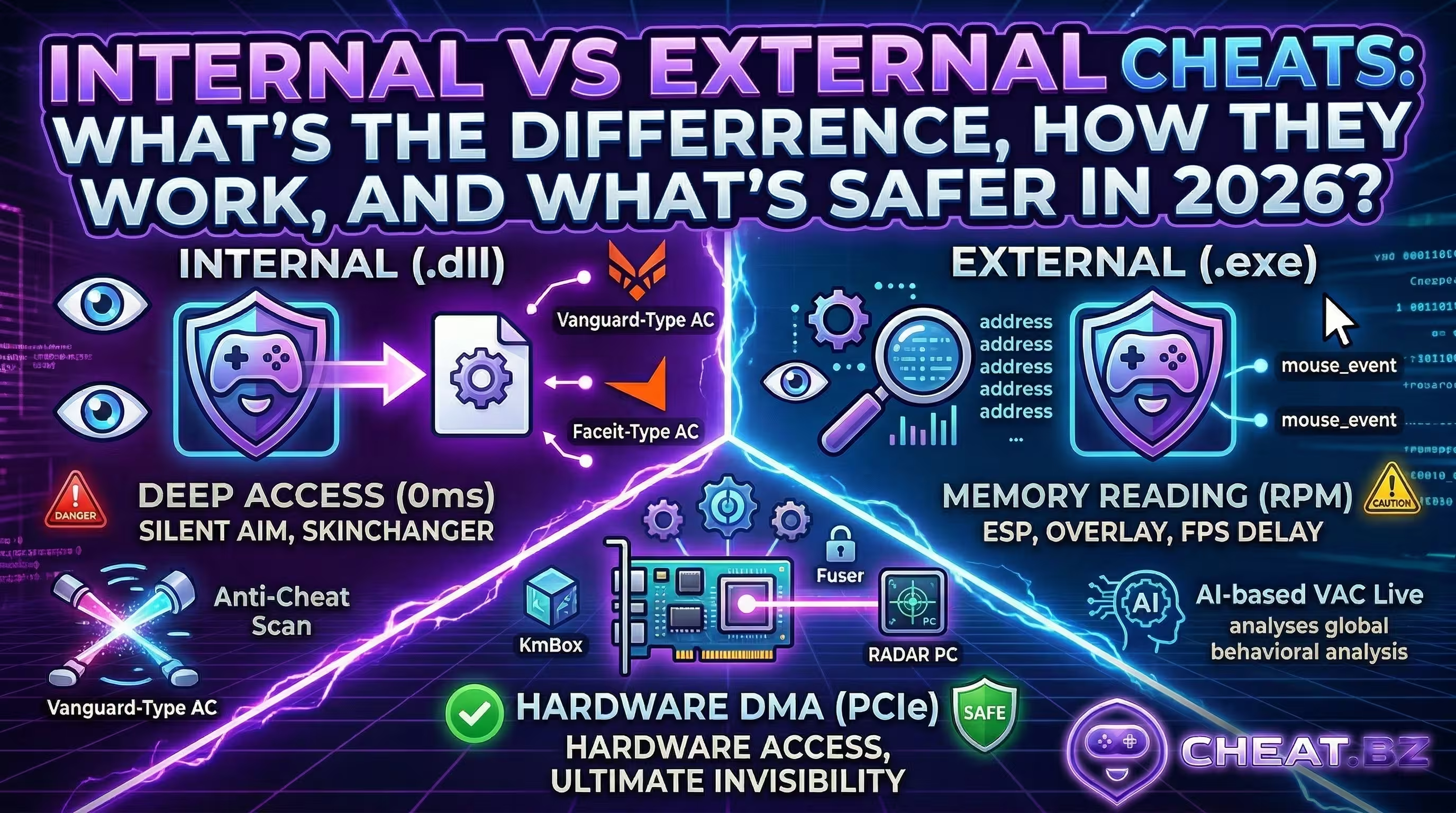
By 2026, video game cheating has evolved beyond the confines of OS software code. Knowing that the Windows kernel is under the total lockdown of modern anti-cheats like Vanguard (from Riot Games) or Ricochet (from Call of Duty), engineers pivoted to hardware attacks.
DMA Attacks: When Anti-Cheat Turns a Blind Eye
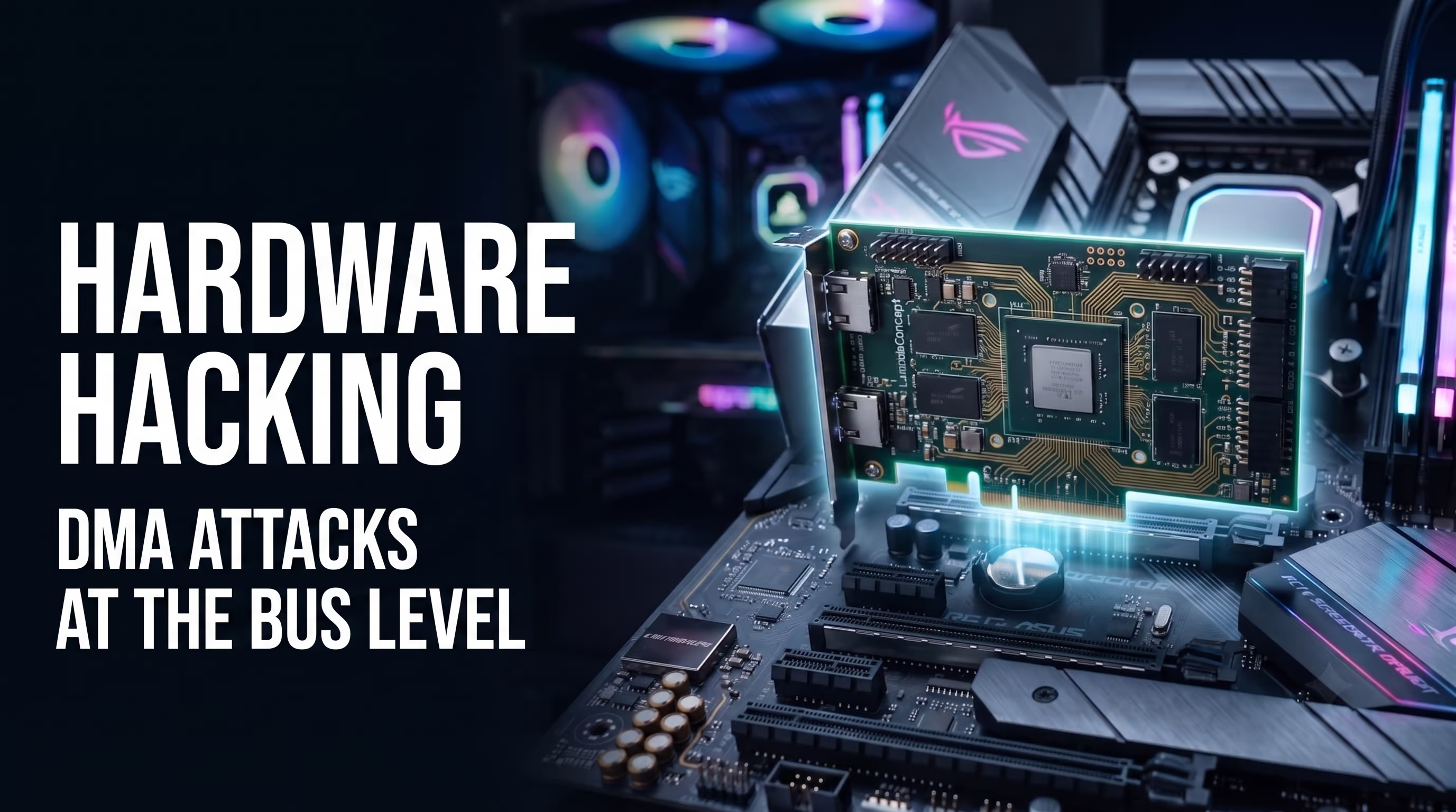
Direct Memory Access (DMA) allows hardware devices to access system memory independently. A specialized PCIe board (typically FPGA-based, like the PCIe Screamer) is installed directly into the motherboard of the gaming PC. This board possesses Bus Master privileges, allowing it to read physical RAM entirely bypassing the central processing unit and the operating system.
Data is then funneled via cable to a second computer where the cheat software is running. The second PC analyzes the memory, renders a radar, or sends mouse emulation commands back. Meanwhile, the main gaming PC remains completely "clean"—there isn't a single suspicious process running in its Windows OS.
AI and Computer Vision: Cheats Without Code Injection
Another major vector in the modern threat landscape is AI pixel bots (Computer Vision). These don't read game memory at all. A video feed from the gaming PC is routed through a capture card to a second PC, where a neural network (most commonly a trained YOLOv8 model) analyzes the frames in real-time to detect enemy silhouettes. A microcontroller (like an Arduino or Raspberry Pi) then generates physical mouse movement signals to track the target. To the server, this looks exactly like a highly skilled human playing with a standard USB mouse.
Anti-Cheats: From PunkBuster to TPM 2.0 and Secure Boot
The evolution of anti-cheat security is just as impressive. The first mainstream anti-cheat, PunkBuster, released in 2000, could basically only take client screenshots and look for primitive injections. Modern systems analyze interrupt vectors, monitor CPU registers, and heavily rely on hardware roots of trust.
Many players find it incredibly annoying when Vanguard or FACEIT AC demands that TPM 2.0 and Secure Boot be enabled in the BIOS. However, it's an absolute technical necessity. TPM 2.0 (Trusted Platform Module) utilizes Measured Boot technology: it hashes every stage of the PC boot sequence inside PCR registers. The server then verifies these hashes via Remote Attestation. If a player tries to load a hypervisor (Ring -1) or a modified bootkit before Windows starts, the hashes will mismatch, and the anti-cheat will block access to the game.
In May 2026, developers took things a step further. Vanguard rolled out an update leveraging IOMMU (Intel VT-d / AMD-Vi). This technology isolates memory addresses at the hardware bus level. If an unauthorized DMA card attempts to read a protected RAM segment, the IOMMU controller throws a DMAR fault and physically blocks the transaction, instantly turning an expensive piece of hacking hardware into a useless brick of fiberglass.

Criminal Business, Psychology, and Esports Scandals
The market for illicit gaming software has fully transitioned into a classic SaaS (Software as a Service) model, complete with monthly subscriptions, 24/7 tech support, and sprawling marketing networks. The history of cheating is marked by several high-profile criminal cases.
In 2021, a massive sting operation in cooperation with major publishers took down one of the world's largest cheat cartels, an organization making millions of dollars selling subscriptions for mobile games. Authorities seized luxury cars, cryptocurrency, and massive server farms. In several global jurisdictions, lawmakers have introduced strict penalties: laws have been passed making the creation and distribution of game hacks a criminal offense, carrying fines of up to $43,000 and actual prison sentences of up to 5 years.
Esports scandals represent a whole different category. One of the most infamous incidents occurred in 2018 at the eXTREMESLAND tournament, where a professional player from OpTic Gaming's international roster was caught red-handed by a tournament admin right on the LAN stage. He frantically tried to delete a file named word.exe, which turned out to be a compiled aimbot. Incidents like these forced tournament organizers (such as ESIC) to dramatically tighten peripheral checks and deploy advanced server-side behavioral analysis (heuristics) to sniff out unnatural mouse micro-adjustments.

Cheat Eras Comparison Table
A brief summary of the evolution of access levels and defense mechanisms in video games.
| Era | Access Level | Tools | Defense Mechanisms |
|---|---|---|---|
| 1970s–1990s | Local (RAM / Bus) | POKE, Game Genie |
Lawsuits (Fair Use) |
| 2000s | Ring 3 (User OS) |
Aimbot, Wallhack, Radar Hacks |
VAC, Packet Encryption (TLS/DTLS) |
| 2010s | Ring 0 (OS Kernel) |
Rootkits, BYOVD, SSDT Hooking |
BattlEye, EAC (Kernel Drivers) |
| 2020s+ | Hardware (Equipment / AI) | DMA Boards, AI Pixel Bots |
TPM 2.0, Secure Boot, IOMMU |
Conclusion
The evolution of unfair play has journeyed from innocent RAM experiments in the 8-bit console era to highly sophisticated hardware attacks using PCIe bus manipulation and neural networks. In response, anti-cheats have been forced to integrate deeply into the OS kernel and mandate hardware-backed security measures like TPM 2.0 and IOMMU. Today, the battle for fair competitive play is no longer just about software patches—it is a full-scale cybersecurity war where the technical stakes are measured in millions of dollars.