

DLL Injectors for Cheats: How They Work & 2026 Risks
When diving into how modern private cheats work, users eventually hit the technical barrier of loading the software. Ever since the early days of multiplayer shooters like Quake or Unreal Tournament, hack architecture has been split into two parts: the cheat library itself and the program that delivers it into the game. Today, with kernel-level protection becoming the industry standard, just finding working code isn't enough. If you don't know how to inject cheats properly, the anti-cheat will ban your account before the loader even finishes launching.
A cheat injector is a specialized delivery tool that injects a third-party DLL library or script into the memory address space of a running game process. The classic injection method uses a chain of Windows API calls: VirtualAllocEx → WriteProcessMemory → CreateRemoteThread → LoadLibrary. However, in 2026, User-Mode injections are detected by security modules in seconds. They have been replaced by Manual Mapping, Ring 0 Kernel drivers, and hardware DMA cards.
In this article, the expert team at the cheat.bz marketplace breaks down the core mechanics of code injection, explains the difference between DLL loaders and Lua executors, and shows why free alternatives are often a one-way ticket to a compromised PC.

The Bottom Line
An injector isn't a cheat itself—it's a tool for stealthily delivering third-party code (ESP, Aimbot) into the RAM of a protected game.
- Core Technology: The injector forces the target process (e.g.,
cs2.exe) to allocate memory and execute unintended code from a.dllfile. - Protection Evolution: The classic LoadLibrary method is dead for online play in 2026. Anti-cheats (EAC, Vanguard) instantly ban accounts for creating remote threads.
- Current Solutions: Only software utilizing kernel-level (Ring 0) drivers or hardware PCIe cards (DMA) survives.
- Roblox Executors: A separate class of programs. They don't inject DLLs; they connect to the internal Lua/LuaU virtual machine.
- Free Version Risks: Searching for the best free cheat injector usually leads to trojan infections and lost Discord/Telegram tokens.
Below, we break down the injection architecture step by step so you understand exactly what happens under the hood of your PC when the loader launches.
Definition: What Is an Injector and Why You Need It
To understand the mechanics, picture a syringe and medicine. The medicine is a dynamically linked library (.dll) containing the code for a vector aimbot or Loot ESP. The syringe is the injector, which pierces the operating system's defenses and injects that medicine directly into the game's "bloodstream" (the process address space).
The injector itself doesn't give you a Wallhack or no-recoil. Its sole function is to execute a code_injection operation. To do this, the utility requests special system privileges from Windows (SeDebugPrivilege), without which the OS will block any attempt to read or write foreign memory.
Injector vs. Cheat vs. Trainer
Many beginners confuse the concepts, trying to launch a DLL file with a double-click. In the table below, we've structured the differences between software formats.
| Software Type | File Format | Requires Injector? | Operating Principle |
|---|---|---|---|
| Internal Cheat | .dll |
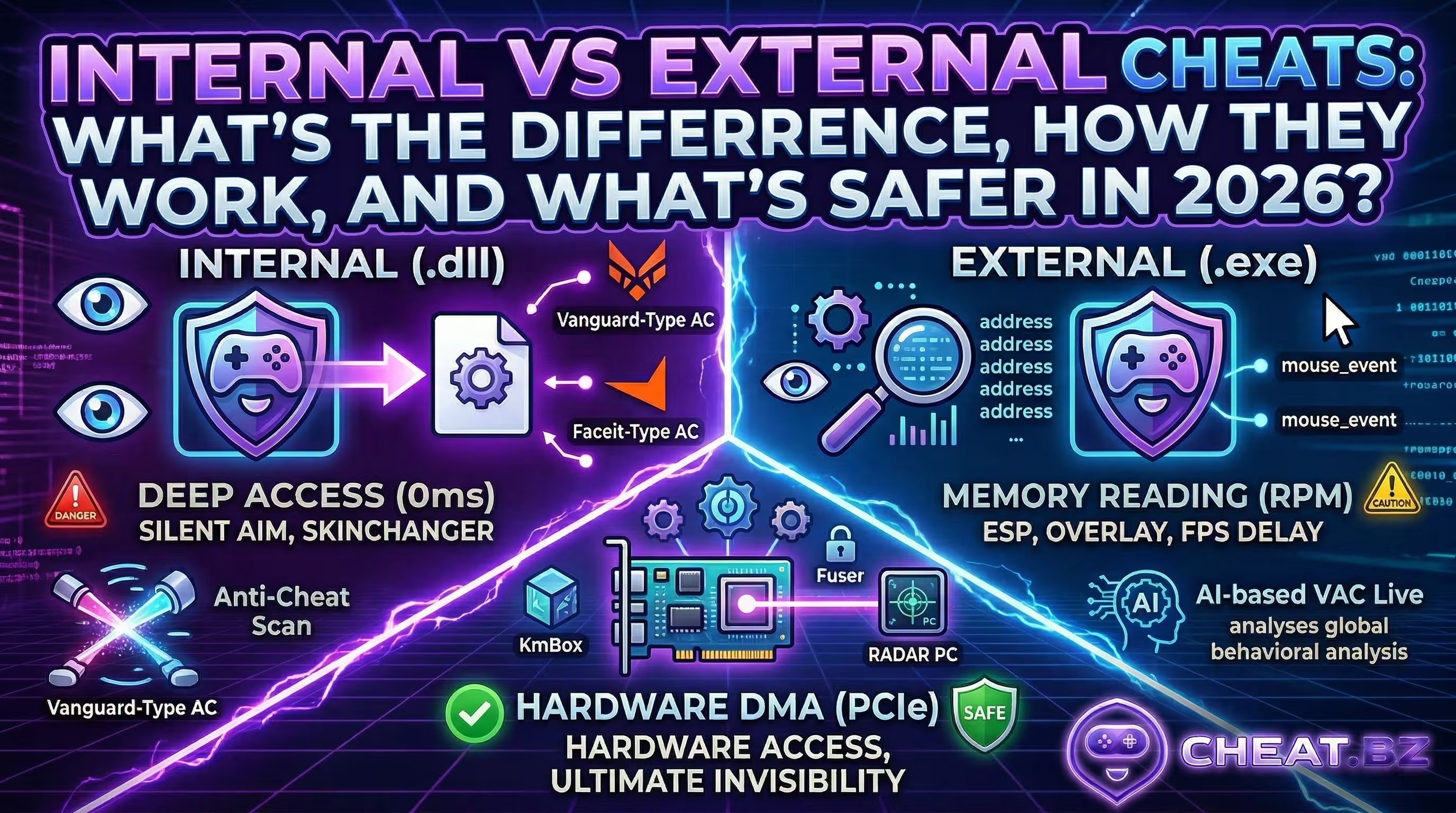
✅ Yes | Runs inside the game. Fast rendering, no input lag, rich features (skinchanger, silent aim). Read more about the differences between External and Internal cheats. |
| External Cheat | .exe |
❌ No | Runs over the game via an overlay. Reads/writes memory externally (ReadProcessMemory). Safer, but limited features. |
| Trainer | .exe |
❌ No | Standalone program for single-player games. Changes local values (money, HP). |
| Roblox Executor | .exe + UI |
❌ No (built-in) | Hooks the Roblox client's LuaU virtual machine to inject scripts, not machine code. |
Why 90% of Cheats Are Distributed as .dll, Not .exe
Files in .exe format have distinct signatures that antivirus and anti-cheat software scan first. If a cheat is compiled as a .dll, it cannot run standalone—it requires a host process (the game itself). Running inside a trusted process (like Escape from Tarkov or CS2), the cheat gains full access to the game engine, can hook DirectX rendering functions, and operates without visible processes in the Task Manager.
How Classic DLL Injection Works: Step-by-Step Mechanics
Technically, the injection process isn't magic. It's a standard Windows API mechanism legitimately used by programs like Discord (for overlays) or OBS (for screen capture). When figuring out how to inject cheats, it's crucial to understand the chain of system calls. A standard DLL cheat injector performs the following steps:
- Acquire Privileges: The injector requests the
SeDebugPrivilegetoken. This is why loaders must always be run as Administrator. - Open Process: Calls the
OpenProcessfunction with thePROCESS_ALL_ACCESSparameter to obtain the Handle (identifier) of the target game. - Allocate Memory: Uses
VirtualAllocExto reserve empty space inside the game for the path to our DLL file. - Write Path: The
WriteProcessMemoryfunction writes a text string (e.g., "C:\cheats\aimbot.dll") into the allocated memory. - Create Thread: The main trigger—
CreateRemoteThread—forces the game to start a new computational thread, passing it the address of the standard Windows functionLoadLibraryA/W.
| API Function | Source Module | Role in Injection |
|---|---|---|
| OpenProcess | kernel32.dll |
Gives the injector read/write rights to the game's memory. |
| VirtualAllocEx | kernel32.dll |
Reserves "empty space" inside the game process. |
| WriteProcessMemory | kernel32.dll |
Physically transfers the DLL path bytes into the game's memory. |
| CreateRemoteThread | kernel32.dll |
Executes code inside the foreign process. |
| LoadLibrary | kernel32.dll |
Standard OS loader that pulls the DLL itself. |
Why CreateRemoteThread Is Detected Instantly
Modern anti-cheats (like EAC and BattlEye) hook kernel-level functions such as NtCreateThread. When your DLL cheat injector attempts to create a new thread from the outside, the protection instantly spots the anomaly. A legitimate game never asks an external process to create threads inside it. The result is an automatic detection and an HWID ban.
The Role of DllMain and DLL_PROCESS_ATTACH
When LoadLibrary successfully loads the library into the process, the operating system automatically calls the entry point—the DllMain function with the DLL_PROCESS_ATTACH flag. This is the exact moment the cheat "wakes up," initializes the Insert menu, hooks DirectX to render the ESP, and begins scanning memory for enemies.
Injection Types: From LoadLibrary to DMA Cards
The arms race between software developers and anti-cheat creators has forced DLL cheat injectors to evolve. Modern methods are classified by their access level (Ring) within the Windows architecture.

LoadLibrary / CreateRemoteThread (Legacy, Ring 3)
The oldest and most detectable method. It only works for offline games without built-in protection (like older Fallout or Skyrim titles). In any online shooter, this method triggers the anti-cheat, and the account gets permanently banned in seconds.
Manual Mapping / Reflective DLL Injection (Ring 3, Stealth)
An advanced User-Mode (Ring 3) method. Instead of using the system's LoadLibrary, the injector parses the DLL file's PE headers, fixes relocations and imports, and manually loads the library into memory.
The main advantage is that it leaves no records in the loaded modules list (PEB). The anti-cheat doesn't see the library with standard scanners. However, modern protections can still find anomalous memory regions via Module Stomping.
APC Injection / QueueUserAPC (Ring 3)
This method avoids creating a suspicious remote thread. Instead, it queues an Asynchronous Procedure Call (APC) to an existing, legitimate game thread. The code only executes when the thread enters an Alertable state. It's stealthier but highly unstable.
Thread Hijacking / SetThreadContext (Ring 3)
The injector suspends (SuspendThread) a working game thread, changes the CPU register values (RIP/EIP) to point to our malicious shellcode, and resumes the thread. It's stealthy but often causes game crashes if the thread is interrupted at a bad moment.
NtCreateThreadEx / Native API (Ring 3)
Uses undocumented functions from ntdll.dll to bypass hooks placed on standard kernel32.dll calls by the anti-cheat. It's effective but risks breaking with any major Windows update.
SetWindowsHookEx (Ring 3, GUI-only)
A legitimate OS mechanism for installing global hooks (like keyboard macro recorders). It's limited to processes with a graphical user interface (GUI). Rarely used today due to strict detection rates.
Kernel-Mode Drivers (Ring 0)
The standard for bypassing top-tier anti-cheats (Vanguard, FaceIT AC). The protection operates at the kernel level (Ring 0) and blocks everything from Ring 3. Therefore, modern private loaders load their own vulnerable signed drivers (or use EFI bootloaders) to gain Ring 0 privileges. From this level, the cheat can use MmCopyVirtualMemory for stealthy memory reading, bypassing all Windows checks. The risk? Blue Screens of Death (BSOD) at the slightest code error.
DMA Cards / Hardware Injection (Outside the OS)
Direct Memory Access (DMA) is a hardware cheat. A special board (FPGA) is inserted into the motherboard's PCIe slot, reading physical RAM while bypassing the CPU and operating system. The data is sent to a second PC (often a laptop) where the radar or ESP runs. Software anti-cheats physically cannot detect this interference. It's the safest, but most expensive, solution on the market.
External Cheats Without Injection (ReadProcessMemory / Overlay)
As established, external cheats don't inject DLLs at all. They run as a separate windowed program and use ReadProcessMemory. All visual rendering is handled by a transparent overlay (ImGui). This lowers the detection risk since no foreign code is written into the game's memory, but it makes features like silent aim or skinchangers impossible to implement.
Roblox Executors: How They Differ from Classic DLL Injectors
The audience often confuses native DLL injectors for PC shooters with script executors for Roblox. Architecturally, they are completely different tools.
| Parameter | Classic DLL Injector | Roblox Executor |
|---|---|---|
| Injection Target | Game process (.exe) |
Lua/LuaU VM inside the client |
| Code Format | C/C++ machine code (binary .dll) |
Text scripts in Lua |
| Bypass Method | Ring 0 drivers, Manual Map | Hooking the internal Roblox engine |
| Countermeasure | VAC, EAC, Vanguard, BattlEye | Byfron (Hyperion) anti-cheat |
| Examples | Xenos, Extreme | Xeno, Delta, Arceus X Neo |
Standard DLL cheat injectors work with CPU machine instructions. Roblox executors are specialized programs that bypass Byfron (Hyperion) protection, connect to the game's script execution environment, and allow custom code to run.

Popular Roblox Executors in 2026: Xeno, Delta, Arceus X Neo
In the current meta, the legendary Synapse X is officially dead. The market is now dominated by new projects:
- Xeno: A popular Windows executor, often positioned as free and operating without a key system.
- Delta Executor: A cross-platform solution supporting Android and PC emulators.
- Arceus X Neo: Focused on mobile gaming (iOS/Android), requiring installation via third-party stores like TrollStore or Scarlet.
Key Systems and Fake Build Risks
Developers of free executors monetize them through key systems—users have to click through 3-4 link shorteners to get a 24-hour key. Here lies the main threat: downloading a random "xeno apk" from unofficial sites means you have a 99% chance of installing phishing software that will steal your sessions and passwords.
Overview of Popular Injectors: Xenos, Extreme Injector, Process Hacker
When searching for the best cheat injector, beginners often stumble across outdated forums and download software that hasn't seen an update in years. Let's break down the popular utilities.
| Tool Name | Supported Methods | Architecture | 2026 Status | Best Used For |
|---|---|---|---|---|
| Xenos Injector | Manual Map, Native, Thread Hijacking | x86 / x64 | [ACTIVE] | Offline games, modding, testing (Open Source, by DarthTon) |
| Extreme Injector | Standard, LdrLoadDll, Manual Map | x86 / x64 (.NET) | [LEGACY] | Outdated in 2017. Triggers 100% of anti-cheats. Do not use online. |
| Process Hacker | CreateRemoteThread | x86 / x64 | [ACTIVE] | Legal debugger. Inject via context menu. |
| SharpMonoInjector | Mono Assembly Injection | x64 | [ACTIVE] | Only for Unity engine games (Rust, Escape from Tarkov). |
Xenos Injector: Capabilities and Limitations
A reliable open-source DLL cheat injector. It can erase PE headers and unlink modules. It excels at Manual Mapping, but its basic Ring 3 functionality is no longer enough for modern EAC or BattlEye without custom drivers.
Extreme Injector: Why It's Outdated
The last stable version (v3.7.3) was released in 2017. The program is written in .NET Framework and uses heavily outdated DLL Scrambling patterns. Anti-cheats know Extreme Injector signatures by heart. Running this software on a PC with active VAC or EAC guarantees a ban within minutes.
Process Hacker / System Informer: The Legal Alternative
Process Hacker (now System Informer) is a free, legitimate replacement for the standard Task Manager. It features an Inject DLL function via right-click. It contains no anti-cheat bypasses, making it perfect for testing custom builds in offline projects.
Unity Game Specifics: SharpMonoInjector and Melonloader
Games built on the Unity engine (like Rust) run in a Mono/.NET environment. Specific injectors like SharpMonoInjector are designed for them, injecting .NET assemblies rather than machine code. In the modding scene, the Melonloader framework is also highly popular.
Antivirus and False Positives: Why Injectors Are Flagged as Threats
Every guide on how to use an injector includes the phrase "disable your antivirus." But why does Windows Defender aggressively delete these files? It's not because Microsoft is fighting cheaters. The issue lies in heuristic analysis.
| Detection Type | What the Verdict Means | Actual Danger |
|---|---|---|
| HackTool:Win32/Injector | AV sees a tool for hacking games or software. | False positive (if the source is reliable). |
| HEUR:Trojan.Injector | Code is suspiciously similar to a trojan algorithm. | Requires a VirusTotal check. |
| Trojan.Stealer / Occamy | A password stealer or miner is embedded in the file. | Critical threat. File is infected. |
The VirtualAllocEx + WriteProcessMemory call pattern is identical to the behavior of real trojan-injectors that inject malicious code into the system explorer.exe. Therefore, the heuristics trigger an alarm.

How to Tell a False Positive from a Real Virus
It's crucial to understand how to use an injector safely. Never run downloaded software blindly. Upload the file to VirusTotal. If 5-10 out of 70 engines flag it as a HackTool or GameHack, that's normal for this type of software. But if 20+ antivirus engines scream about Trojan.Stealer, Ransomware, or CoinMiner, delete the file immediately.
Anti-Cheats and Detection: How VAC, EAC, BattlEye, and Vanguard Catch Injections
Before attempting to inject a cheat online, you need to understand the enemy. Modern anti-cheats operate at the kernel level and see right through the system.
| Anti-Cheat | Popular Games | Level (Ring) | Primary Detection Vector | Surviving Injection |
|---|---|---|---|---|
| Vanguard | Valorant, LoL | Ring 0 (Boot-time) | Blocks unsigned drivers at PC startup. | DMA cards, Private Kernel Driver, AI Aimbots. |
| EAC (Easy Anti-Cheat) | Rust, Apex Legends | Ring 0 | Monitoring PsSetLoadImageNotifyRoutine. |
Ring 0, DMA, Advanced Manual Map + Spoofer. |
| BattlEye | DayZ, R6 Siege | Ring 0 | Memory scanning for signatures, Kernel Callbacks. | Ring 0 drivers, DMA. |
| VAC Live | CS2 | Ring 3 / Server-side | Behavioral analysis, remote thread detection. | Internal (with hook bypass), External. |
Why Anti-Cheats Look for the Loading Method, Not the Cheat Itself
Creating a signature for every new .dll library is impossible—coders update cheats daily. Therefore, anti-cheats (EAC, BE) strike at the root: they look for the fact of injection itself. As soon as the system logs anomalous memory allocation in a protected process, the account is flagged for the next ban wave. This is why top-tier private software spends 90% of its resources on developing a safe loader, not the cheat functions themselves.
Risks and Security of DLL Injections
Using third-party software is always playing with fire. If you decide to study the history of cheating in practice, be prepared for the consequences:
- VAC / Game Ban: Permanent blocking of your Steam/Origin account. All skins and progress are burned. In extraction shooters like Escape from Tarkov, you lose your stash, which is worth thousands of hours of grinding.
- HWID Ban: The anti-cheat permanently blacklists your motherboard serials, drive IDs, and MAC address. You won't be able to play even on a new account without using a spoofer.
- Malware Threat: Downloading free injectors from YouTube or sketchy forums is a 99% guarantee of installing a trojan-stealer. You will lose access to Discord, Telegram, emails, and crypto wallets.

Security Checklist for Testing (Single-Player Games)
If you want to test a mod or custom library in offline mode, follow these rules:
- Use an isolated virtual machine (VMware/VirtualBox) or a sandbox (Windows Sandbox).
- Always run the loader through VirusTotal.
- Create a system backup (Restore Point).
- Never test unknown software on your main Steam/Epic Games account.
Injection Methods Comparison Chart
For convenience, we've compiled all technical parameters into a single matrix. This will help you understand which method suits your needs.
| Injection Method | Level (Ring) | Key API / Mechanics | Stealth | Implementation Complexity | Anti-Cheat Detection | 2026 Relevance |
|---|---|---|---|---|---|---|
| LoadLibrary | Ring 3 | CreateRemoteThread | Extremely low | Easy | 100% detect (EAC, BE, VAC) | [LEGACY] |
| Manual Mapping | Ring 3 | PE mapping without OS API | Medium | High | Detected by memory scanners | [PARTIAL] |
| Thread Hijacking | Ring 3 | SetThreadContext | Low | Medium | High game crash risk | [LEGACY] |
| APC Injection | Ring 3 | QueueUserAPC | Medium | Medium | Medium detection | [PARTIAL] |
| Kernel Driver | Ring 0 | MmCopyVirtualMemory, EFI boot | High | Very high | Bypasses User-Mode hooks | [ACTIVE] |
| DMA Hardware | Outside OS | PCIe FPGA, physical RAM read | Absolute | Extreme (requires hardware) | Invisible to software AC | [ACTIVE] |
| Lua Execution | App Level | Lua VM hook | Depends on Byfron | Specific (Roblox) | High HWID ban risk | [ACTIVE] |