

What Is a Triggerbot in Video Games? How Triggerbots Work
Since the early days of the GoldSrc engine and primitive auto-shoot scripts, game cheats have evolved drastically. Today’s competitive shooters like CS2 and Valorant demand pixel-perfect precision, where matches are decided by micro-adjustments rather than milliseconds. Developers continually deploy server-side machine learning modules to analyze player behavior, but the technological arms race never stops. When you line up a crosshair perfectly and time your shot, only to get dropped instantly by a headshot, server tickrate or ping isn't always to blame. More often than not, your opponent simply automated the mouse click. In our experience, a subtle triggerbot provides an invisible edge that human reaction time physically cannot beat.

Summary at a Glance
A triggerbot is a feature in video game cheats that automatically registers a left-click (shoot) command the exact millisecond your crosshair passes over an enemy's hitbox. Unlike an aimbot, it never moves your mouse; it simply automates the trigger pull once your aim is on target.
- Core Difference: Aimbots move your crosshair onto targets automatically, whereas triggerbots only fire after you manually align the crosshair.
- Reaction Speed: Human visual reaction speed averages 150–250 ms. Algorithmic response times drop to 2–10 ms.
- Operating Principle: Divided into two primary approaches —
Memory Read(internal game memory reading) andPixel Scan(external on-screen pixel color analysis). - Detection Risk (2026): High. Modern AI anti-cheats flag rigid click patterns, meaning proper
Gaussian Random Delayconfiguration is critical to avoid bans. - Pro Setup: Experienced players in the cheat.bz private cheat store ecosystem rely on triggerbots paired with
Humanizationfeatures for realistic gameplay across FACEIT and Premier matchmaking.
Below, we break down how to bypass server-side telemetry, choose the right software for your playstyle, and why outdated configuration techniques no longer work.
What Does a Triggerbot Do and Why Use One?
Newcomers often assume game cheats only consist of blatant rage hacks or map-wide aim locks. To understand what a triggerbot actually does, picture an ideal esports sniper holding a tight angle. You place your crosshair on the edge of a wall where an enemy is expected to peek. The moment their model enters your crosshair, the software generates an instant left-click input. The shot fires long before your brain can process the visual stimulus and signal your finger to click.
Esports Physiology: The Limits of Human Reaction Time
Understanding why players use triggerbots comes down to human biology. Professional players spend years training on maps like Aim_Botz to achieve consistent 150–160 ms reaction times. The average casual player reacts in 200–300 ms. A software script triggers the click in 1–10 ms. In tactical shooters where a single headshot decides the engagement, this speed gap guarantees a win in any direct pixel-peek duel.
Time Efficiency and the RMT Factor
In hardcore extraction shooters, automation becomes even more critical. Losing high-tier gear and valuable loot simply because a camper reacted a fraction of a second faster resets hours of grinding. Real-Money Trading (RMT) farmers rely on auto-shoot features to safeguard their inventory during high-stakes raids. It offers a practical advantage: why risk valuable gear when an algorithm can hold angles with perfect consistency?
Anatomy of Auto-Shooting: How Triggerbots Work
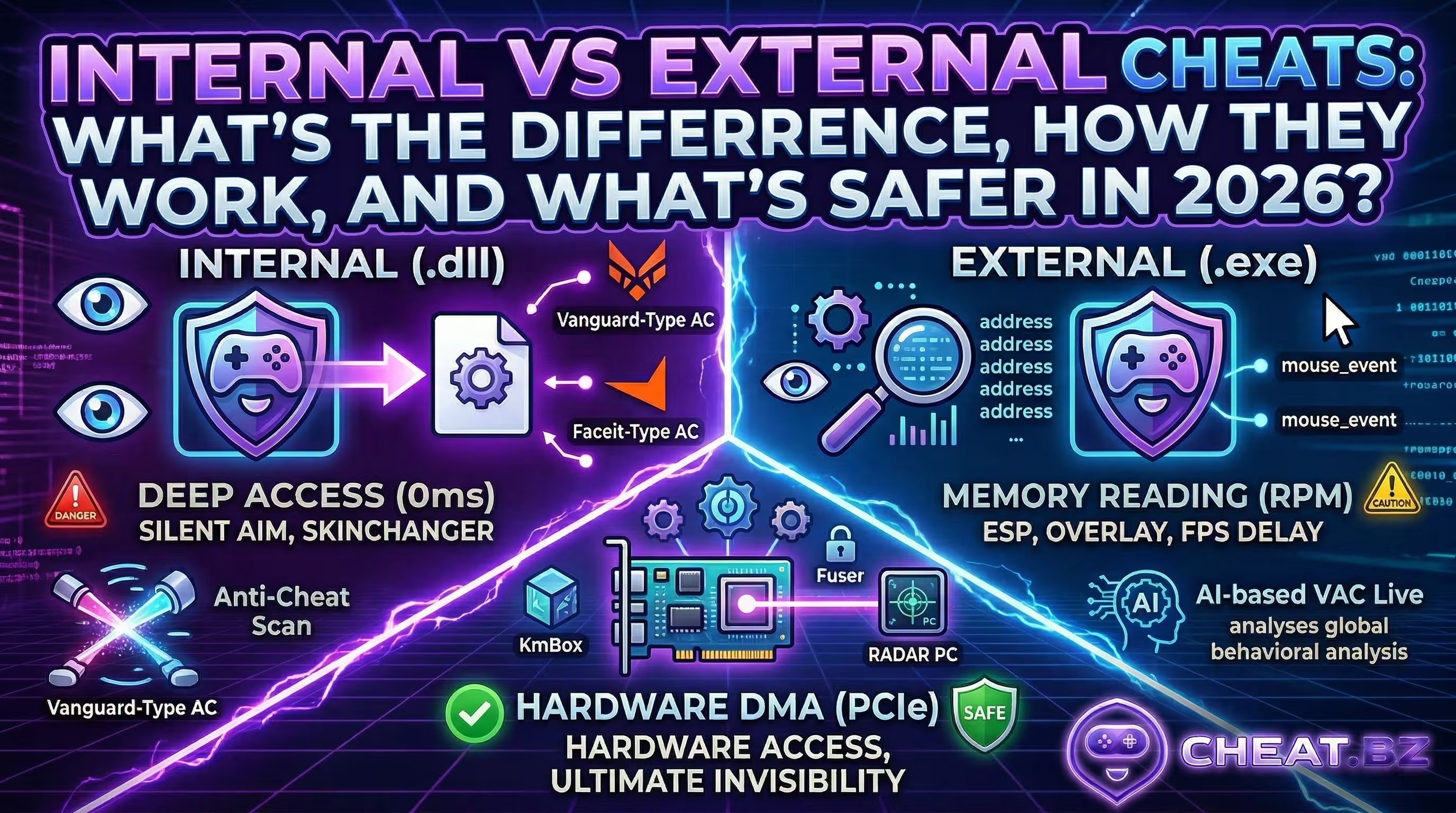
Discussions on Reddit and community forums frequently debate which architecture offers the best security. Understanding how triggerbots operate under the hood helps you choose the right tool. Triggerbot software generally falls into three technical categories: memory reading, pixel analysis, and hardware-level access.
1. Memory Reading (Internal Methods)
Internal memory reading is the traditional, fastest, and most feature-rich method. The cheat loads as a DLL library injected directly into the game process to read system RAM. When your crosshair hits a target, the local client already knows which player model is in view. The cheat algorithm checks the EntityID variable. If the ID falls within active player limits (e.g., 1 to 64), it issues a mouse_event firing command.
- Pros: Sub-millisecond execution delay (near-instant response). Offers reliable filtering, such as
Visible Checkto prevent firing at teammates or through solid walls. For clean, legit play, users often choose established internal solutions like the VRedux private cheat for CS2. - Cons: Kernel-level (Ring 0) anti-cheats like Vanguard or Easy Anti-Cheat (EAC) easily detect unauthorized threads and memory modifications unless the loader uses kernel driver bypasses.
2. Pixel Scanning (External Overlays)
Computer vision cheats do not read game RAM. Instead, they capture screen frames hundreds of times per second and scan the frame buffer for specific RGB color values. When target highlight colors (such as purple or yellow enemy outlines) cross the center of the screen, the software triggers a click. The primary setting relies on Color Tolerance adjustments.
- Pros: Superior protection against signature scans. The cheat operates strictly as an external window overlay, remaining undetected for extended periods.
- Cons: Risk of false positives. Bright player skins, colored smoke, or grenade visual effects can trigger accidental shots. Response latency is slightly higher (2–10 ms), depending on frame rate, monitor refresh rate, and GPU render delay.

3. DMA Hardware: Hardware-Level Access
Direct Memory Access (DMA) represents hardware-level cheating. A specialized PCIe card plugs into the motherboard to read system RAM directly, bypassing the host Windows kernel (Ring 0). Because a PCIe card cannot issue mouse_event commands directly to the main OS, a hardware triggerbot requires a second PC alongside a hardware microcontroller (such as an Arduino or Raspberry Pi with KMbox). The secondary device processes DMA data and physically emulates mouse clicks on the primary gaming PC. This makes the setup virtually invisible to software scans. However, in May 2026, Riot Games began actively bricking public DMA firmware, forcing developers to adopt custom PCIe transaction spoofing.
| Architecture Method | Execution Latency | Detection Mechanism | Security Profile (2026) |
|---|---|---|---|
| Memory Read (Internal) | < 1 ms | RAM EntityID Parsing | Risk without kernel driver |
| Pixel Scan (External) | 2–10 ms | Screen RGB Pixel Analysis | High (No injection) |
| DMA (Hardware) | Hardware Click | PCIe Direct RAM + 2nd PC | High (Firmware block risk) |
Triggerbot vs. Aimbot: TTK Math and Choosing the Meta
Choosing the right tool requires understanding how each mechanic alters gameplay. An aimbot is active: it overrides mouse input to pull your crosshair onto target hitboxes based on Smooth and FOV settings. A triggerbot is passive: it never adjusts aim, relying entirely on your placement while automating shot timing.
This distinction makes Time-to-Kill (TTK) a decisive factor when choosing your loadout:
Low-TTK Games (CS2, Valorant): The One-Tap Meta
In tactical shooters where weapons like the Vandal, AK-47, or AWP eliminate opponents with a single bullet, triggerbots frequently outperform traditional aimbots. You don't need target tracking—holding head height at a tight corner allows the software to deliver instant one-taps as enemies peek. The movement remains completely natural to spectators, stream viewers, and demo reviewers because the mouse avoids robotic snap movements.
High-TTK Games (Apex Legends, The Finals)
In fast-paced battle royales requiring full-magazine sprays against targets executing advanced movement like superglides, a standalone triggerbot struggles. Without target-tracking mechanics, auto-fire stops the moment an enemy moves past the crosshair. In high-TTK environments, vector aimbots remain the dominant choice.

Legit Setup: Bypassing AI Anti-Cheats in 2026
Relying on raw response speed without proper masking leads directly to flags. Modern anti-cheat systems do not rely solely on signature detection; they analyze behavior patterns. If auto-fire triggers at an exact 5 ms delay 100 times consecutively, server-side neural networks automatically flag the account for automated input.
In our testing, configuring Humanization features is essential for maintaining safety on main accounts:
Gaussian Random Delay: Humanizing Inputs
Avoid static delay values in cheat menus. Setting a constant 150 ms delay triggers heuristic flags in systems like VAC Live. Utilizing Gaussian Random Delay generates shot timing across a normal distribution curve (e.g., between 135 ms and 185 ms), accurately mimicking human neurological variance and subtle imperfections.

Visible Check via Raycast (Smoke Verification)
A critical safety setting. The cheat casts an invisible vector beam (Raycast) from your character camera to the target model. If geometry or smoke obstructs the line of sight, auto-fire suppresses the shot. Disabling this check causes suspicious firing through dense smoke whenever hitboxes cross your crosshair, prompting instant manual reviews.

Recoil Check and Spray Management
Recoil checking prevents auto-firing while your crosshair is displaced by weapon recoil. This ensures shots only fire once recoil settles back on target, preserving spray control and preventing wasted ammunition during weapon recoil recovery.
Anti-Cheat Heuristics: How VACnet and Vanguard Detect Software
Anti-cheat architectures in 2026 rely heavily on behavioral heuristics. Riot’s Vanguard and Valve’s updated VACnet utilize machine learning to evaluate player telemetry in real time. Simply hiding background processes is no longer sufficient against server-side behavioral modeling.
Telemetry Analysis: Mouse Delta and Time-to-Click
When a player reacts to an emerging target, physical hand movements create micro-adjustments (Mouse Delta) right before clicking. Triggerbots operating without Reaction Jitter exhibit abnormal telemetry: flawless Time-to-Click response paired with zero mouse movement during execution windows.
Hardware Bans: Protecting System Components
Behavioral anomalies often lead directly to hardware ID (HWID) bans. Anti-cheat engines register unique identifiers from motherboards, MAC addresses, and drive serials. Players testing unverified software rely on a kernel-level HWID Spoofer to virtualize hardware identifiers and prevent permanent hardware blacklisting.
Game Engine Specifics: How Triggerbots Differ Across Titles
Engine architecture impacts how auto-shoot features execute across competitive games:
Counter-Strike 2 (CS2) Sub-Tick Architecture
Source 2 changed input processing through its sub-tick architecture. In CS2, CUserCmd packets attach exact timestamps within server tick intervals rather than relying on render frame timing. Internal CS2 cheats hook CUserCmd generation directly inside the network stack, bypassing mouse API input lag.
Valorant and Vanguard On-Demand Scanning
Vanguard maintains active kernel protection from Windows bootup. Standard internal memory injection presents severe detection risks in Valorant. Modern private cheats for Valorant utilize AI object recognition (such as YOLO neural networks) or hardware DMA setups to ensure main account safety.
Escape from Tarkov (EFT) and Extraction Shooters
Losing high-end kits and valuable items like LEDX in Escape from Tarkov carries steep progression penalties. Players often utilize comprehensive private cheats for EFT that pair triggerbot functionality with Loot ESP, securing combat engagements while efficiently locating high-value loot across maps like Customs.
Conclusion
While players spend hundreds of hours training reaction speeds, dealing with hit registration issues, or losing gear to bad luck, understanding cheat mechanics levels the playing field. Explore detailed technical guides on the cheat.bz blog to stay informed on game engine algorithms and modern anti-cheat developments.